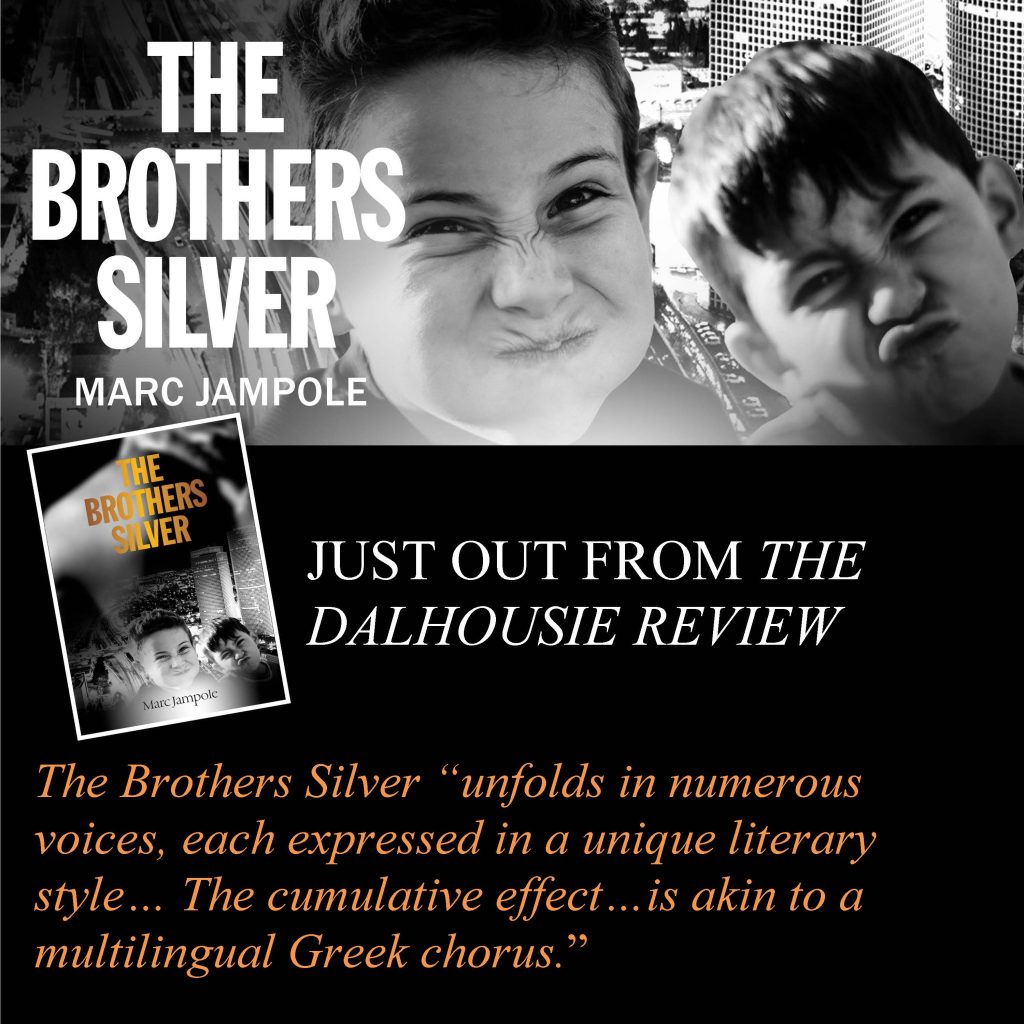
GREAT REVIEW OF THE BROTHERS SILVER IN THE LATEST VASSAR REVIEW:
Countering Culture by Jessica de Koninck
The Brothers Silver by Marc Jampole (Owl Canyon Press, 2021)
Stories of family trauma, parent-child relationships, and sibling rivalry are part of the human psyche. They are central to the opening stories of the Bible as well as to those of earlier traditions. In the original trauma, God expels Adam and Eve from the garden. Eve gives birth to two sons. Sibling rivalry begins, culminating in Cain murdering Abel. Am I my brother’s keeper? (Genesis 4:9) is a question that continues to repeat. The Book of Genesis is filled with dysfunctional families and siblings with difficult relationships – Isaac and Ishmael, Jacob and Esau, Joseph and his twelve brothers. The patriarch, Abraham, sets out to kill his son, Isaac. Death, deception, and betrayal characterize our earliest tropes.
Into this tradition enters The Brothers Silver, the first novel by poet and non-fiction writer Marc Jampole. The book represents a highwater mark in the history of stories of family trauma and sibling rivalry and the kind of book you want to talk with someone about after reading. It is also a story of the Baby Boom generation, and the time period from the late 1940s to the turn of the 21st century. The story crosses the continent from East to West and North to South, starting in Queens, NY, and moving on to Florida, Illinois, California, parts of the West, and back to the East Coast. Novels by men about sibling rivalry are not new. Consider the various intrigues in the similarly titled The Brothers Karamazov. Parenthetically, one of the pleasures of reading The Brothers Silver is the many literary and other references and allusions scattered throughout. There is no detriment to not recognizing them, but recognition adds its own thrill. Again, like Jacob and Esau, The Brothers Silver concerns two brothers, Jules – the older, and Leon – the younger. Typical of many families, particularly those with absent parents, the older son is the caregiver, but also deeply competitive, fearful of losing his birthright. Meanwhile, the younger is detached and depressed, but strong, smart, and handsome.
Less typical of novels written by men, The Brothers Silver is an in-depth exploration of the impact of childhood family trauma on the lives of two boys whose parents are abusive and neglectful. Their father, Ed Silver, who asserts that “all women are whores,” is a largely absent narcissist, unwilling or unable to provide financial or emotional support. Their mother, Ethel Silver, experiences severe mood swings and errant behavior, leaving her unable to hold a job, care for her children, or manage anything about her life.
Writing about family trauma is also not new to literature, though it has unfortunately and often disdainfully been negatively characterized as confessional writing in both memoir and poetry, as if certain life experiences were either too embarrassing or too unworthy for literary exploration. In conversation, Jampole noted: Being a victim myself of childhood abuse and neglect, and someone who struggled it an adult – the largest part of the struggle being admitting it, because I am, of course, male – I basically wanted to write about this subject.
Jampole writes from the poetic tradition. Despite the brilliance of the poet Robert Lowell, who may reasonably be called the progenitor of confessional writing, there appears to remain a sense that the exploration of feelings belongs to the realm of women writers and is less serious or worthy as subject matter. The Brothers Silver rejects that negative assessment and unflinchingly explores the origin and impact of childhood trauma. The novel explores its lifelong impact and the difficult and long-term work necessary each day in order to survive. Childhood trauma, Jampole noted in conversation, is not like a disease that you cure; it’s a disability that you learn to live with.
The book opens with the two young boys, Jules and Leon, wrestling, on the dusty floor of what turns out to be the courtroom chambers of the judge in their parents’ divorce hearing. The scene is heartbreaking. The nightmarishness worsens as their mother, popping pills, drives the boys home and, in a stupor, must be persuaded out of the car. There is an argument in the kitchen with their father about signing the divorce papers. Sometimes the house is clean, and meals are available. Often the boys are left to fend for themselves. Their situation, contrasted with Jules’s happier recollections and hopes that things may change for the better, only gets worse. The brothers remain helpless in the face of their mother’s repeated suicide attempts and inability to hold a job and their father’s physical absence and emotional unavailability.
The Brothers Silver is also a literary novel. As a result of both the authenticity of the child’s voice and Jampole’s use of language, the opening chapter is extremely powerful in establishing the source of trauma. For those who read for writing, the Brothers Silver is a glorious adventure. While the remaining chapters are not as fluid or compelling as the opening one, each drives the narrative, explores the possibilities of language and form, and mixes genres with fluidity. The text is keenly attuned to music, from the rhythms that permeate the chapters to the songs playing in the background or on the radio. Indeed, music, chess, politics, and philosophy are just a few of Jampole’s interests that The Brothers Silver has sufficient gravitas to explore.
The Brothers Silver contains twelve chapters, each of which can be read as an individual work, But the whole is larger than the sum of its parts. The opening chapter, “On the Cold Hill’s Side,” is particularly effective as a stand-alone piece. “Hashmal,” a hilarious drug-crazed romp through a soon-to-be-closed Mikvah (Jewish ritual bath) appeared in publication previously. Each chapter is written in a distinct voice and style. It is a work of literary fiction in the best tradition thereof. It harkens back to the mixed genre explorations of John Dos Passos, one of Jampole’s early influences. As noted, “On the Cold Hill’s Side” is recounted in the voice of a pre-adolescent child. Jampole carefully employs the language and diction of childhood. At the same time, the adult reader’s understanding of the consequences of Ethel and Ed Silver’s behavior makes the experience for the reader and the reader’s compassion for the children that much more intense. While set forth on the page in prose format, the opening chapter is largely written in rhyme and meter. The attention to sound has a trance-like effect, pulling the reader along into the childhood world of Jules and Leon. Jampole, in conversation, emphasized his interest in writing novels using rhyme and the relationship between rhyme and meter to create emphasis. His use of poetic strategies to drive the narrative voice, with each phrase amplifying the next, contributes significantly to the effect of the opening chapter as a whole.
For example, this excerpt finds the Silver boys in the kitchen: Inside, sleeves above my elbows, tie unclipped, I search the fridge and cabinets for something we can eat. Eggs to scramble, grated cheese, some onion dip, a box of Cream of Wheat. I talk of Mantle’s injuries to Lee, Howard at the plate replacing Yogi, how Whitey with a mighty curveball put a collar on Sherm Lollar, why I think the Reds will tank, why Matthews is as good as Ernie Banks, Cepeda, McCovey, other Giants. I speak to fill my brother’s silence. Not only has Jampole established the setting of a boy working to feed himself and his brother and provided a time frame with the use of baseball examples, but, significantly, the hypnotic iambicpace filled with rhyme – “Lee” and “Yogi,” “collar” and “Lollar,” “tank” and “Banks” – creates an immersive experience for the reader. Immediately before recounting the trauma that closes “On the Cold Hill’s Side,” Jules recites a lengthy lyric daydream in an attempt to fit together the broken pieces of his life. The reader understands that nothing makes sense to Jules and that, though he has been warned not to, he will blame himself for whatever has happened or will happen.
As with each succeeding chapter, the second chapter shifts tone, voice, and writing style. Jampole believes it essential to tell the story in different voices in order to gain a more complete perspective on the characters and their situation. Chapter Two is a soliloquy in the voice of Ed Silver, father of Jules and Leon. The boys are now on the verge of adulthood, Jules is in college, and Leon has taken off for San Francisco. This claustrophobic use of monologue is a particularly apt vehicle for a character with a limited world view who is deeply narcissistic. He understands neither his older son’s idealism nor the younger’s distance.
The third chapter moves to dialogue in the voice of secondary characters, an aunt and uncle. This may be the least successful of the chapters as an experiment in the use of language. Its emphasis on Southern dialect often feels forced and the characters one-dimensional. Yet the next chapter, a third-person dramatic dialogue, skillfully personifies Jules’s feelings by affording each one of the characters a literal voice. Here’s a brief sample in which the language feels fresh and satisfying. Guilt: Unconscious mother, barking television, plastic vials, glass half filled with water, knew it was all my fault. Shame: Stupid, stupid, stupid, not to see her breathing. Not to see she was still alive. Anger: I knew she was alive. I wanted her to die.
Another chapter is in the form of a letter. Like the first chapter, the final chapter is lengthy, approximately one-third of the entire book. It, too, is in the voice of Jules, now an adult, forty or so years after the first chapter. Like the opening chapter, the final one, titled “Along an Unknown Highway,” employs poetic strategies, but here the vocabulary, syntax, and diction are those of an adult in which Jules takes a lengthy road trip.
Jampole pays homage to the long tradition of road trip stories with a quote from among the earliest, and certainly the best-known, opening with a quote from the beginning of Dante’s Inferno. The epigraph reminds the reader that it may be necessary to go through Hell to have any hope of getting even as far as Purgatory, let alone Heaven.
The extended road trip affords the opportunity to explore the turn of 21st-century American Zeitgeist. It’s a lamentation for the promise of the 1960s and the disappointing realities of the 2000s. Jules, driving alone, traverses the country to visit with an assortment of characters from his past, including people met while hitchhiking. Indeed, hitchhiking, a largely lost 20th-century phenomenon, is a central metaphor of The Brothers Silver. What would Jack Kerouac have had to say had he repeated his own road trip?
The opening paragraphs of the chapter, through their use of poetic tropes as well as literal language, make Jules’s road trip one that occurs both within and transcending space and time: The tumbling sky shivers like my bleary body from the wind of speeding cars and trucks. Squinting drivers steer into a quivering solar ball that singes roads and signs, sears the fences, flames the crows and ducks. In my sight, glowing malls cross horizon’s edge and welkin squid-ink stains the spurge and sedge, leaches roofs and building cranes, dims the city structures into specks of light.
The birth of night releases cicada humming, beetle scuffles, wind and spider throws. Moisture stumbles over dell. Wind song and cricket clatter swell and grow to ostentatious silence. A white noise knells. Time ceases giving hints of its existence. Jules’s journey is most compelling when it affords him the opportunity to meditate or advances the narrative. His trip is less interesting when the characters begin to feel more like stereotypes than archetypes, and the narration becomes didactic rather than revealing.
There’s one of almost everyone – the drug dealer turned physician or politician, a lawyer who represented draft evaders now a management labor lawyer, a born-again Christian, black, white, gay, straight, inhibited, uptight. More men than women. With the exception of Ethel Silver, the female characters, including Jules’s former girlfriend Elaine, whom he calls El, are, for the most part, less fully realized than the male. There’s nothing particularly fresh about a drug dealer who grows up to be a psychiatrist. In light of the serious psychiatric problems among his family, more interesting is Jules’s aversion to medication for ADHD, and, by implication, other medications for psychiatric disorders.
The adult Jules, like most of the characters he encounters, has given up the idealism and hedonism of youth for financial security, routine, and certainty, but he was never an actor who tried to effect change. His principal and most important skill is survival, while his observations about complacency border on the trite: But I was, nevertheless, part of the obscene machine that ground down the dream of a social democracy that we seemed on the path to reaching in the mid-seventies. I once believed fervently in the possibilities of a social democracy overseen by a real meritocracy, where everyone had a chance to thrive, a green land that provided a minimum standard of living, and free healthcare and education to all, financed by taxes on the wealthy, something like France or Scandinavia. That was then. Has my later apathy been any different from Dean’s? Yet his occasional focus on who has gained too much weight is entertaining and creates a sense of reality.
Jules’s reactions to, and coming to terms with, who each of these characters both was and has become ground the story and maintain momentum, even when the people themselves begin to become repetitive. Similarly, Jules maintains his feeling of being an outsider throughout. While the ideological/political thread in the story of Jules’s trip feels somewhat forced and superficial, his continuing meditation about his failed relationship with Elaine provides a deeper understanding of Jules’s character. The reader is left almost as baffled as Jules himself at his subsequent ability to establish and maintain a long-term marriage and a stable relationship with his daughter. He believes it relates to his ability to view himself as the perpetual outsider.
His outsider status is the wall Jules has created to distance himself from his emotions. Yet his ability to connect with people he has not seen for years, his successful career as well as the family relationships of his adulthood, feel grounded and real and speak of a level of hard work and commitment for which Jules never gives himself credit. That lack of acknowledgment of self-worth resonates as the residue of a traumatic childhood. It is a corollary to taking on the perpetual role of outsider.
None of us is truly our brother’s keeper. We can offer help or guidance, but, in the end, we can only live our own lives. And none of us can escape whatever trauma life has brought us. The challenge is how to live with trauma. Do we live in denial, build walls to shut out feelings? Do we live in perpetual adolescence without daring to explore the possibilities of adulthood? The damage of childhood trauma, will, to a greater or lesser extent, always be permanent. The challenge presented by The Brothers Silver is the challenge to survive.
“REMOVE THE CAP” SHOULD BE DEMOCRAT’S ELECTION-YEAR BATTLE CRY
In the “State News” section of the latest AARP Bulletin, the American Association of Retired People (AARP) solicits volunteer advocates in New York, Vermont, and other states to speak with state legislatures about a variety of issues. But nowhere in the publication does AARP ask for volunteers in the national fight to preserve Social Security benefits. That’s because AARP doesn’t have any program to fight for Social Security, either by its staff or with volunteers.
I pored over the AARP website and found plenty of useful information about who’s eligible to receive Social Security, what the potential benefits are, how to apply for Social Security, how to compute whether you have to pay taxes on Social Security benefits and how much you’ll have to pay, and other important consumer information that people need to know about the program. (arp.org)
But nothing about preserving Social Security.
And yet twice in the same AARP Bulletin asking for volunteer advocates are two—count them, two!—explicit references to Social Security’s trust fund running out of money in 2033. Both times, AARP focuses on the possible reduction of benefits to 78% of what they currently are if nothing is done. AARP treats the future gutting of Social Security benefits almost as if it’s a fait accompli.
Of course, AARP isn’t the only organization to be ignoring a dire problem that will affect virtually every non-wealthy American in 12 years: how to live with reduced benefits after planning that Social Security would be a major retirement income source? The Democratic Platform expatiates at length in pious generalities about making Social Security more progressive and rejecting “every effort to cut, privatize, or weaken Social Security, including attempts to raise the retirement age, diminish benefits by cutting cost-of-living adjustments, or reduce earned benefits.” But not one single concrete proposal about keeping Social Security financially solvent.
The Democrats do have a Social Security bill before Congress that, among other things, will postpone the 2033 date for the depletion of the Social Security reserves until 2038. But again, no concrete permanent solution to the Trust Fund running out of money.
The Republicans, of course, want to privatize Social Security, so that what people get in benefits depends on how well they maneuver the ever-evolving, ever tempestuous financial markets. Most Republicans express delight at the thought of the Social Security Trust fund going bankrupt.
In the past, experts and politicians have proposed several ways to deal with the impending shortfall, including raising the retirement age, increasing the Social Security tax (known duplicitously as the “payroll” tax), lowering benefits, and borrowing from general funds. The last idea makes some sense since the federal government has been borrowing from the Social Security Trust Fund for years—another 1980’s Reagan move to avoid raising taxes on the wealthy while spending on defense as if we were actively fighting wars on six fronts; the trouble was, it increased the overall federal deficit, so it didn’t really address the underlying fiscal crisis of too few tax revenues.
Little is said about a simple, elegant, and fair solution to the Social Security funding crisis, one that will also go a long way towards addressing the problem of growing income and wealth inequality: remove the cap on income assessed the Social Security tax.
Right now, income—from minimum wage up—is taxed 6.2% that goes into the Social Security Trust Fund. But no 2021 income over $142,800 gets taxed ($147,000 in 2022), making the Social Security tax as regressive as possible, which means it removes fiscal responsibility from those making more than $142,800 and puts it on the back of those making less money. And it’s more regressive than ever, because so much income wealth has collected in the hands of relatively few people, another negative impact of growing wealth and income inequality. The cap has gradually been increasing, by 70.5% in total over the past 20 years, or 8.5% a year.
The Congressional Research Service estimates that if we removed the cap on income assessed the Social Security tax while keeping benefit maximums the same, it would push back the depletion of the Social Security Trust Fund by 30 years. And a lot can happen in 30 years. For one thing, we’ll be through the retirement years of the Baby Boom generation, whose enormous size compared to previous and future generations (save maybe millennials) has created the Social Security shortfall by virtue of so many people retiring compared to the overall population. Another possibility is that we begin accepting immigrants again, replenishing our shrinking population of younger, healthier workers to support retired workers.
Progressives, liberals, and Democrats have all supported a number of causes over the past few years that have been encapsulated into one catch phrase: #MeToo, Black Lives Matter, Pride, and Defund the Police all represent traditional and patriotic ideas of fairness and equality, and all propose clusters of viable solutions to pressing social problems. But all have the drawback of being expressed in a way that the right can undermine. The right has distorted the meaning of these slogans—and by implication, all they represent—to feed their base of the uneducated and rural whites with the fresh meat of lies and misrepresentations. The right wing has easily twisted #MeToo, Black Lives Matter, Pride, and Defend the Police into the other side of an “us versus them” fight for survival and the soul of America. Progressives and Democrats love these movements and what they represent, but their articulation in sloganeering has made them prone to the right-wing smear. Thus, they have ended up dividing the country, making it harder to address the challenges posed by these movements.
But how could the right wing contort “Remove the Cap and Save Social Security” into something that threatens the culture and financial security of poor and middle class whites, educated or not?
The Democrats have looked desperately for an issue they can use to wedge into the mass of Republican voters and pry off enough votes to build additional strength in the Senate and House and control more state governments. Every issue with which they come up the Republicans use to stoke resentment against some group—minorities, women, immigrants, LGBTQ+ movements, scientists. In the picture they paint for their base, every Democratic initiative threatens to take away the base’s wealth and give it to the undeserving poor or threatens to overwhelm their traditional way of life with immoral city ways.
But what could anyone possibly say against saving Social Security by taxing rich people?
Perhaps the reason the Democrats shy away from discussions of removing the cap is that all of their large contributors and so many other contributors make more than $142, 800 a year. One interesting variation on removing the cap is to do it gradually by creating a donut hole: all income under $142,800 and above $400,000 would be assessed the Social Security tax, exempting the heart of the upper middle class. Over time, as the cap increased, less income would fall into the exempt donut area, until finally the donut would cease to exist; that process would take about 13 years if the cap continues to advance by 8.5% a year. The short-term loss of Social Security revenue would be substantial, but it would make the idea of removing the cap more politically palatable.
For decades, Social Security has been the third rail in American politics—a beloved institution that politicians try to dismantle, privatize, or in other ways harm at their own risk. Putting Social Security front and center is a winning issue for Democrats—either Republicans have to agree to strengthen it or they risk losing lots of votes, even among the fiercest Trumpites.
“Remove the Cap” or “Remove the Cap to Save Social Security” should be one of the rallying cries of Democrats and anyone else wanting to move the country leftward. It’s a winning issue. As a wedge issue, it’s the left’s equivalent of abortion.
I fear that the Democratic party is going to need a little prodding to feature “Remove the Cap” as one the central rally cries of the 2022 and 2024 elections. I implore all readers to contact their Congressional representatives and Senators once a month asking them to develop and support legislation that removes the cap on income assessed the Social Security tax. Also tell your friends. Share this article on Facebook and Twitter. We have to keep the focus on this issue, not just as a means of showing poor and middle class Republican voters that Trumpism is not in their economic best interest. Because if something isn’t done soon, many of us will find themselves in poverty conditions starting in 2033.
ANOTHER GREAT REVIEW OF THE BROTHERS SILVER.
Here’s an excerpt from the Fall 2021 issue of Main Street Rag: “Jampole’s experimentation is an intriguing, if sometimes challenging, way to stretch the novel form. Readers who are willing to put in a little work to digest the meandering poetic style will enjoy its freshness. There’s plenty to chew on for anyone curious about the impact of dysfunctional families on children who make it to adulthood.” To order the issue, go to the Main Street Rag website: https://mainstreetragbookstore.com/product/the-main-street-rag-fall-2021/
Buy The Brothers Silver on Amazon: https://www.amazon.com/Brothers-Silver-Marc-Jampole/dp/1952085071/
At Owl Canyon Press: https://www.owlcanyonpress.com/product-page/the-brothers-silver-a-novel
At Barnes and Noble: https://www.barnesandnoble.com/w/the-brothers-silver-marc-jampole/1138658640?ean=9781952085079
NEW REVIEW OF THE BROTHERS SILVER FOCUSES ON SOCIAL CRITICISM IN THE NOVEL
Here are excerpts from the latest positive review of The Brothers Silver:
“Jampole sees present-day America as a brutal right-wing Inferno, where the sufferers become the opposite of their gentle youthful incarnations… The recent riot/failed coup/insurrection/tantrum/ragefest at the Capitol in Washington, DC, makes Jampole’s warnings look prescient. “
– Your Impossible Voice, September 21, 2021
For more: https://www.yourimpossiblevoice.com/review-the-brothers-silver/
Buy The Brothers Silver on Amazon: https://www.amazon.com/Brothers-Silver-Marc-Jampole/dp/1952085071/
At Owl Canyon Press: https://www.owlcanyonpress.com/product-page/the-brothers-silver-a-novel
At Barnes and Noble: https://www.barnesandnoble.com/w/the-brothers-silver-marc-jampole/1138658640?ean=9781952085079
THE LATEST SNAKE NATION REVIEW HAS THREE OF MY POEMS
Included is one of my personal favorites among all the poems I have written over the decades, “The Beach in Winter.” If you like it, buy the issue and see my other two poems: https://snakenationbooks.store/product/snake-nation-review-issue-28
THE BEACH IN WINTER
That winter day we didn’t drive
along the shore, didn’t watch the waves
explode berserkly over snow banks,
didn’t stop to take a photo
on a boardwalk bench,
plug quarters into telescope
to track a distant steamer chug towards ocean
underneath a clutch of rising seabirds,
didn’t hurtle snowballs bare-hand at the water,
didn’t wrap our shivers in a shroud of steam,
but stood at window sill and counted taxis
as they lurched through slush
and talked of how we loved
to walk along the beach in winter.
- Marc Jampole
Published in Snake Nation Review #28 (2021)
THE BROTHERS SILVER IS NOW AVAILABLE AS AN AUDIO BOOK
My new novel, The Brothers Silver, is now available on audiobook: https://www.amazon.com/The-Brothers-Silver-A-Novel/dp/B09CFMMGDW/ref=tmm_aud_swatch_0?_encoding=UTF8&qid=&sr=
The reader, Donald Davenport, has a great interview about the joys and challenges of narrating The Brothers Silver in a Dungball Express podcast: https://thedungballexpress.libsyn.com/the-brothers-silvers-silver-tongue
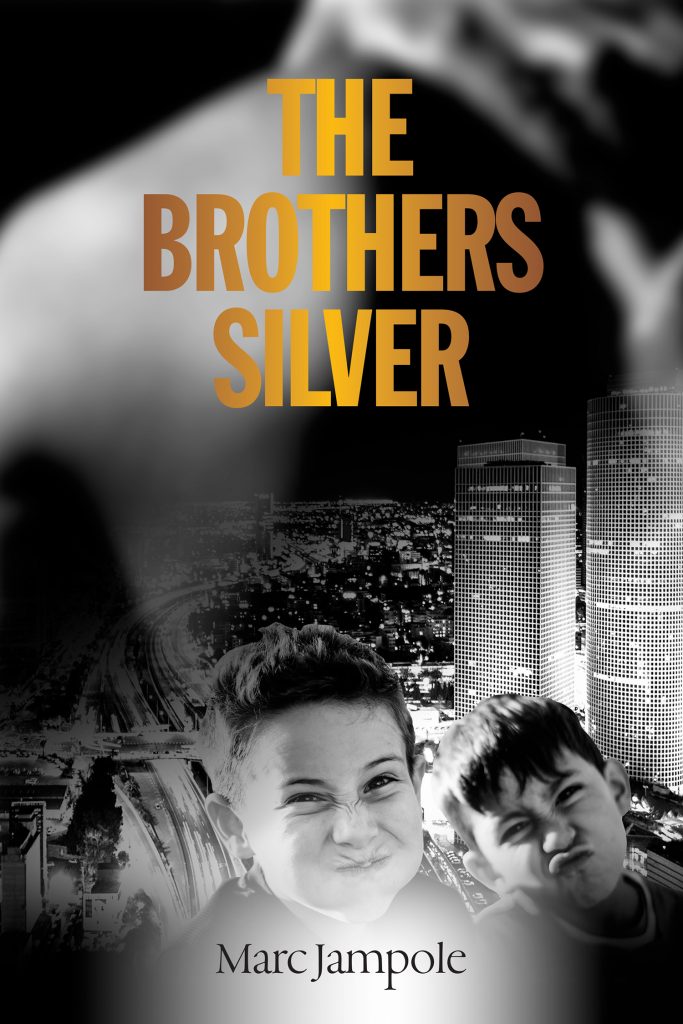
Prairies Book Review article on The Brothers Silver Calls It “Powerfully Told…. A Soaring and Haunting Tale…”
In the May 29th edition of the Prairies Book Review:
The Brothers Silver by Marc Jampole
Powerfully told… A soaring and haunting tale. Transcendent and hard-hitting, Jampole’s ambitious literary tale takes readers into meandering lives of two brothers as they try to survive their traumatic childhood. With a mother who is prone to frequent mental break-downs, attempting suicide more than often and a father who is never there, the brothers Jules and Leon Silver’s lives are more than troubled. They barely survive their traumatic childhood, venturing on different life paths later. Will they heal or lose themselves in insecurities and chaos of their earlier lives? Jampole writes with an assured hand as he describes the intricacies of the boys’ bond with each other and their parents. The shifts and complexities that happen in the Silvers’ lives are ripe with ups and downs and make more than a mere backdrop of other people’s tortured stories. With poetic precision, Jampole captures the brothers’ emotions of helplessness, insecurity, and confusion and a sense of a new possibility (experienced by Jules while on his long road trip). He beautifully conveys their constant struggles, inner turmoil, the shared trauma, and the underlying restlessness, and in due process, he not only delves into their sibling bond but also the questions of bad parenting, long-lasting effect of childhood trauma, family ties, relationship woes, mental, physical, and emotional abuse, and how healing is a difficult journey and how some people never heal whereas for others it takes a lifetime of struggle and introspection. The brothers’ past is revealed in a series of flashbacks throughout the narrative. Jules’s and Leon’s resilience make them shine, making the reader root for throughout their struggles of finding a meaning in life. Jules dominates the narrative but loses his shine in front of Leon as the story moves forward. Realistic and utterly complex, the secondary characters inhabit a vivid, convincing private world of their own, truly coming alive in readers’ minds. As the story progresses, the reader realizes that the novel is much more than two boys’ struggles to get through their growing years: it’s a well-crafted mixture of exploration of childhood trauma, abusive relationships, and substance abuse with in-depth analysis of how with passing years, the nation’s moral fabric is gradually disintegrating, with new-age cultural shifts in the society on the rise. Lyrical, assured storytelling, fully fleshed-out characterization, and moving insights contribute to a story that’s guaranteed to make a lasting note in readers’ minds. Fans of literary fiction won’t want to miss this one.

Buy The Brothers Silver on Amazon: https://www.amazon.com/Brothers-Silver-Marc-Jampole/dp/1952085071/ref=tmm_pap_swatch_0?_encoding=UTF8&qid=&sr=
At Owl Canyon Press: https://www.owlcanyonpress.com/product-page/the-brothers-silver-a-novel
At Barnes and Noble: https://www.barnesandnoble.com/w/the-brothers-silver-marc-jampole/1138658640?ean=9781952085079
Violet Snow’s Review of The Brothers Silver Published in The Adirondack Review
Here is Violet Snow’s review of my new novel, The Brothers Silver, that was published a few weeks back in The Adirondack Review:
What are the forces that make us who we are? How do siblings grow up in the same environment but come out with different characteristics, different attitudes toward the world, and different fates? In his novel The Brothers Silver, Marc Jampole traces the paths two brothers take to adulthood, surviving, by the skin of their teeth, a suicidal mother and a sadistic father.
The brilliant younger brother, Leon, is the favorite of his parents. They still take out their frustrations on him, but the older brother, Jules, who is nearly as smart, is jealous of their undisguised preference for Leon. They both emerge from childhood with qualities of cynicism and self-indulgence. Although the guilt-wracked Jules is the point-of-view character, somehow he comes off as less sympathetic than his brother, who is determined to live in the moment, with a minimal sense of responsibility. He doesn’t seem a whole lot happier than the aimless Jules, who does whatever seems easiest in any situation, while berating himself for not doing more.
Interestingly, although they are both troubled and selfish, they do not become abusers like their parents. Jules is drawn irresistibly to unlikeable people, as if unconsciously trying to work out his relationship with his parents through interactions with psychotic friends and vicious lovers. He has a tortured intimacy with El, a woman who is as manipulative as his parents were; however, although he’s subject to fits of anger, he doesn’t treat her nearly as badly as his father treated his mother. He eventually gets wise and leaves her, winding up in a placid marriage, working a white-collar job, and fathering a daughter we don’t get to know, although she seems pretty okay. Check off a plus for Jules, for not victimizing his own kid, even though he himself was a victim.
Jampole experiments with the novel form, blowing it open through an array of styles and viewpoints that meet with varying success. Each of the main characters gets a chapter or two in the first person, but Jules owns the bulk of the narration, beginning with a childhood overview written in a poetic style scattered with rhymes.
I found myself preoccupied with the rhymes through much of the first chapter. I would hold my breath, waiting for the pairs to emerge:
She curses bitterly, a shrieking fanfare about Dad deserting us. The TV clicks on, and now its steady blare.
The rhyme of “fanfare” and “blare” is so gentle, I almost missed it, while I got a jolt of pleasure from recognizing the pattern.
The question is, do I want to be so distracted by the rhymes that it’s hard to concentrate on the story? It’s true that there’s a touch of exhilaration to Jampole’s rhymes, especially when they’re most unexpected. They pull the reader along on rippling sounds that combine in scintillating ways. But it’s jarring when one comes along that goes splat:
“Are you out of your mind, of course it’s my business.”
“I won’t take pressure, no duress.”
But I’ll accept that Jampole is playing with words while telling a story. He seems to be more interested in sound than in strictly reproducing voice, as long as the truth is embodied.
By the time I hit page 24, I’d stopped grasping for the rhymes and learned to ride them. Rhyming became a tide, washing in and out, carrying me along as Jules washed on the tide of his mother’s insanity, his father’s spasmodic neglect.
I applaud Jampole for his experimentation, even if I couldn’t always appreciate it.
In his sixties, Jules takes a road trip and looks up people he met on a youthful hitchhiking odyssey. In each encounter, he finds the wild idealism, rebellion, and/or hedonism of the ’70s has deteriorated into a conservative, exploitative lifestyle that Jules considers reprehensible. The tattoo artist now traffics in illegal immigrants. The frat-boy drug dealer is buying a seat in Congress.
The long chapter containing this journey appears to serve three purposes in the novel. Jules’s visits with past comrades bemoan the loss of idealism in the world that the U.S. has become, making a political and moral statement that seems to belong in a separate book. Between these many little morality tales, he meditates on his relationship with Leon and recalls his disastrous relationship with El. Presumably, the often hallucinatory memories, evoked by long nights on the road, have a therapeutic effect on Jules. They also fill in gaps in the story for the reader’s benefit.
I suppose the whole chapter is witness to the person he has become as a result of his upbringing, but the thread to the morality tales is tenuous. However, the start of the book and the second half are linked by Jampole’s return to the poetic style in the long final chapter.
The increasingly non-linear chronology requires a go-with-the-flow attitude on the part of the reader, to match the rambling poetic phrasing:
I imagine an ancient tree, as gnarled and knotted as my brain-constipating thoughts beside a rotting bridge of selves transforming into future selves, all wallowing in praise and blame, pleasure, pain, loss and gain, ups and downs, while El seems to slide from lotus leaf to lotus leaf down the shallow river to a waiting tiger, which she rides to a distant town.
To pass the time while driving alone, Jules makes lists: the differences between himself and Leon, the many women he’s had sex with, the ones he didn’t have sex with, ways one can change, ways to prepare for death, ways El drove him crazy — this last list confirming he really was dealing with his mother:
She falsified my meanings, turning yes into no, fast into slow. Her dramatic preening — her brawling, burning, Gothic mistrals — sounded like my mother’s shtick, if my mother had studied forties flicks.
Finally, Jules heads home to New York, his lists replaced by disturbing familial memories, in kaleidoscopic sequence. By the time he arrives, he has abandoned the past and come to rest in the present:
A muggy ocean breeze teases with its wheezes. It glides between the buildings, reminding me the seas are near. It fills the streets with sticky nuzzles and the puzzle of the clouds…
And we can all take a deep, cleansing breath. The Brothers Silver requires patience and persistence, but an adventurous reader will find much to entertain and provoke.
VIOLET SNOWis a freelance journalist whose articles have appeared in the New York Times “Disunion” blog, Civil War Times, American Ancestors, The Sun Magazine, Jewish Currents, and numerous other periodicals. Woodstock Times has published her reviews of books and films.
Buy The Brothers Silver on Amazon: https://www.amazon.com/Brothers-Silver-Marc-Jampole/dp/1952085071/ref=tmm_pap_swatch_0?_encoding=UTF8&qid=&sr=
At Owl Canyon Press: https://www.owlcanyonpress.com/product-page/the-brothers-silver-a-novel
At Barnes and Noble: https://www.barnesandnoble.com/w/the-brothers-silver-marc-jampole/1138658640?ean=9781952085079
Review in Jewish Chronicle: Former Pittsburgher’s Novel of Jewish Brothers Affected by Harrowing Childhood
Dionna Dash’s review of The Brothers Silver in the July 9, 2021 edition of The Jewish Chronicle:
“The Brothers Silver,” a tale of two brothers growing up in the wake of intergenerational family trauma, is the haunting and realistic debut novel from public relations executive and poet Marc Jampole — a former Pittsburgher and past president of New Light Congregation. After 32 years in Squirrel Hill, Jampole moved back to his hometown in New York four years ago and now serves on the board of Jewish Currents, a national arts and politics publication.
In Jampole’s novel — which focuses a realistic lens on dark themes like drug use, domestic abuse, mental illness and suicidal ideation — Jules and Leon Silver are raised by their suicidal mother and lecherous father, hopping between New York City and Chicago. The brothers become accustomed to their mother’s numerous attempts to take her own life and their father’s distance and neglect, eventually leading to Leon’s drug addiction and Jules’ entanglement in a manipulative relationship.
The novel traces the brothers’ lives from the 1960s until present day as they attempt to escape a fate sealed generations before their births, painting a portrait of parental abuse and reverberating trauma.
Jampole’s background writing poetry and short stories is evident in this novel, as each of its 12 chapters is written in a different voice and from a different perspective. One chapter is formatted as a letter, one is almost entirely dialogue between the boys’ aunt and uncle, and another shows Jules’ emotions conversing among themselves. It often uses a poetic prose, including inventive rhyming phrases at the end of paragraphs that lend a rhythm to the story. The writing style demands a close, focused read from its audience, allowing for deep connection with the novel’s many themes, but rendering it inaccessible to the casual reader.
“The Brothers Silver” relies on Jewish references, as well as those from other religions, to help its plot unfold. The inclusion of Jewish scripture against the backdrop of a trauma-ridden existence offers a compelling case study of religious disillusionment throughout the book. Integration of Jewish themes and practices in the chapters heighten the imagery of this novel and lend it a personal authenticity and a sort of sacredness, yet those themes remain subtle enough to not overpower the rest of the narrative: Jules struggles with feelings of being an outsider, which echoes much of the historical Jewish experience.
Jules and Leon each deal with their trauma differently, leading Leon to become a self-identified “deadbeat” who rejects modern society, while Jules enters a relationship with a woman named El that is all too reminiscent of his parents’ catastrophic marriage.
Jules maintains a constant fear of death following an unfulfilling life, and is forced to confront that fear at every turn, especially after the rest of his family has passed away. Despite this dread, or perhaps because of it, he seems to regenerate a new life every few decades, shedding people and personalities and cutting himself off from more and more family members. This ultimately culminates in a 150-page road trip to retrace the players from the time of his life when he was in his destructive relationship with El. Unfortunately, this chapter becomes repetitive at times, with many of the characters being near recreations of each other with similar life trajectories.
There is an ambiguity at the end of this novel reminiscent of short stories in which the reader is left with enough closure to feel satisfied, yet still wonders what might happen next. This book does not have one ultimate, final message, but rather traces the lives and deaths of the members of the Silver family through all their gritty, candid struggles, allowing readers to decide which perspectives to trust and what conclusions to draw.
This novel is ideal for those who appreciate poetic writing with a Jewish undercurrent and want a realistic look at what it means to survive with unresolved trauma. “The Brothers Silver” is not a light read, but rather one that requires its audience to introspect on their own lives, their own beliefs and their own personal ordeals. PJC
Buy The Brothers Silver on Amazon: https://www.amazon.com/Brothers-Silver-Marc-Jampole/dp/1952085071/ref=tmm_pap_swatch_0?_encoding=UTF8&qid=&sr=
At Owl Canyon Press: https://www.owlcanyonpress.com/product-page/the-brothers-silver-a-novel
At Barnes and Noble: https://www.barnesandnoble.com/w/the-brothers-silver-marc-jampole/1138658640?ean=9781952085079