The latest “Tiny Moments,” just out, has my poem, “The Hummingbird”:
The Hummingbird
Same day late July, every year by backyard fence,
single blur of beryl green and ruby, finger-length,
squeaked like sneakers running polished wood,
hovered over foxglove and impatiens,
unseen long bill probing pink and purple,
unseen tongue grooves lapping pollen,
unseen stretched wings stroking circles.
I called my son and got the camera,
panned it through the flower bed,
clicking, clicking, clicking to incarcerate
the hummingbird’s frenetic path,
and always failed to frame its flight
or fleeting sudden stop and perch on petal,
the boy meanwhile with rounded hands
hunted after, shoveling through the air
and crooning, not a teeny helicopter, not a bug.
Decades later scrutinizing family photographs,
he wonders why I took so many
out-of-focus shots of backyard flowers.
To buy the issue: https://www.bronzebirdbooks.com/
Minyan Magazine has just published “Eve Offers Adam a Cyclamen”
Dogs and dancers dominate the imaginary world created by TV commercials
About nine years ago, I wrote an OpEdge article that in the idealized world of television commercials people care about their pets as much as they do about their children. At the time it seemed as if every other commercial featured dogs or cats, and in most, the animal was a best friend, family member, or even life guide. The article went on to analyze several commercials featuring pets.
Since then, I have never lost the feeling that pets dominate televisions commercials, but the post-pandemic increase in the popularity of pets makes me wonder if instead of being a major creative motif in communicating about products that pets have become a given, like furniture, family, and cars, in an idealized commercial world to which the viewers can only find entry through the purchase of the advertised goods and services. Recently I have noticed a new trend in television commercials related to the creation of an ideal world dominated by the unrequited longing for consumption and the warm emotional release of making a purchase: dancing.
Damn, doesn’t it seem as if every commercial that doesn’t have pets shows someone dancing, ecstatically happy because of the purchase and use of whatever is being advertised?
Unlike my article of nine years ago, I decided to test out my hypothesis that dogs and dancers dominate TV commercials by watching not just commercials with dogs or dancing, but every TV commercial I could see over a week. I turned the normal TV watching experience on its head, channel flipping towards the commercials instead of away from them. I watched at several times of day, focusing my attention on broadcast and cable news and entertainment stations. No sports channels, for a highly personal reason: the preponderance of ads touting gambling and online gambling sites on sports channels disgusts and depresses me. I know that there are plenty of beer and car commercials on sports channels, too, but I figured I would pick those ads up on other stations.
I saw and made a note of 305 television commercials over the period of a week that aired on 22 broadcast and cable channels. I did not count or make a note of public service announcements or promotions for televisions shows or networks, the latter representing a curious combination of cross-marketing and cannibalization. Of the 305 commercials, I removed 42 from the discussion because they were obviously made on shoestring budgets, and to feature either a pet or dancing requires a good budget. You need to pay either an animal trainer and the owner of the animals or the choreographer and dancers.
That left me with 263 commercials of which:
- 39 featured pets (14.8%)
- 24 featured dancing (9.1%)
Much less than I thought, but still substantial use of these motifs considering the enormous number of themes, images, situations, locations, times, plotlines, interpersonal relationships and dynamics, facial and body expressions, and emotions from which to choice when creating a 15- or 30-second televisions commercial.
Of the 39 commercials featuring pets, 10 were for pet food and other pet products. If we net those 10 out, the battle between dancing and dogs suddenly becomes very close, with each represented in about 10% of all commercials (excluding the ultra-cheapies).
But it does say a lot about our society that the category of commercials for pet products comes in tenth in companies advertising, ahead of hospitals, home and furniture stores, department stores, supermarkets, clothing, cosmetics, attorneys, computer services, toilet paper, liquor, delivery services, and travel. Here are the top 10:
| 1. | Junk food and candy (27) |
| 2. | Financial products, including insurance (26) |
| 3. | Cars and car products (24) |
| 4. | Prescription drugs (20) |
| 5. | Soap and cleaning for people and homes (18) |
| 6. | Telecom (16) |
| 7. | Over the counter healthcare products (13) |
| 8. | Fast food restaurants (12) |
| 8. | Food products not junk (12) |
| 10. | Pet products (10) |
To the degree that advertising reflects reality, we have become a nation of clean people living in clean houses addicted to junk and fast food that we eat while on the phone in our cars headed to the pharmacy to fill a prescription.
Besides pet products, dogs and cats appear in ads for prescription drugs, crafts, junk food, banks, department stores, hospitals, and cars. Sometimes pets are the center of these commercials, but just as often, they are part of the scenery, like furniture, wall hangings, paved streets, buildings, computers, and children.
We can see dancing in a similar mix of products as those containing dogs: cars, telecom, financial services, hospitals, food, fast food restaurants, prescription drugs, department stores, and delivery services. In all these commercials, though, dancing represents one thing and one thing only: the ecstatic joy at improving one’s life and achieving happiness through the purchase and use of a product or service.
These people are so happy they could dance. And how did they get this happy?
By buying something.
Be it that wonderful feeling of a fresh mouth that gum gives you, or the infinite happiness that fills you when you buy a fashionable top on sale, or the addictive buzz in the brain that a piece of candy drills into you, or the sheer exhilaration of knowing that your basement and closets won’t collect moisture anymore, or the sudden burst of joyful energy that your skin has cleared up (despite the diarrhea, constipation, liver damage, and hot flashes you may suffer)—whatever the problem and product, it’s solved now and that means we can dance our booties off. Dancing means you are happy in CommercialLand, and happy means you have bought something.
Minyan Magazine has published “Eve Offers Adam a Cyclamen”
Minyan Magazine has just published my poem, “Eve Offers Adam a Cyclamen,” my take on the Adam and Eve myth.
Eve Offers Adam a Cyclamen
Some say it’s an apple, some say an orange
or fig—hanging at arm’s length
from one branch of a tree of life,
the product of action, not action itself,
which would be the cyclamen bloom,
thin stem twisted and bowed in prayer,
petals of deep velvet folded back
exposing anthers and stigma,
which remain hidden under leaves, each a still
photo of an exotic fan dance, appearing
to reveal what it conceals: a red spot of sorrow
the heart carries years after consummation.
For more, go to Minyan magazine: http://www.minyanmag.com/marcjampole.html
Free To Be Whatever You Want To Be As Long As You Consume
The “Barbie” movie completes the conversion of Barbie from a symbol of paternalistic sexism to a hero of feminism.
Nobody but old Boomers will remember that when Barbie first came out in 1959, it quickly became a symbol of women’ subjugation to traditional paternalism—her oversized breasts alone seemed to fulfill a man’s fantasy more than a woman’s and certainly served as a terrible image model for preteens, who could never hope to have the fantasy figure that Barbie showed. Criticism of Barbie focused on concerns that girls considered Barbie a role model and might emulate her, leading to anorexia and bulimia, an epidemic of which started sometime in the 1970s among teenaged girls. Some research connected the unrealistic body proportions in Barbie dolls to this increase in eating disorders in children.
Moreover, Barbie was interested only in fashion clothes, and then in boys when Ken came along. A perfect doll living in a pre-Nora doll’s house. I remember in the late 1960s and early 1970s hearing people call women who cared about nothing but consumerism or who dressed as fashionable teases “Barbie Dolls.” It was not a compliment.
Barbie always had careers, but at the beginning they were traditional female service or allurement professions. She started as a fashion model, but quickly added fashion designer, singer, ballerina, flight attendant in the day when only women had that job, cheerleader, candy striper, and student teacher. Note that Barbie did not get to be a real nurse or real teacher, professions known for their intellectualism, not for their subservience to a male idea of beauty.
Oh yes, one of Barbie’s early careers was as a businesswoman, and that was what the Barbie collection was always about. Business. But somewhere along the line, Mattel, out of the desire to extend the brand and sell more merchandise (it was before the days when we simply called branded junk “merch”), decided to fight the criticism and turn Barbie into a modern, liberated woman. By 1973, there was a surgeon Barbie, but the start of the new Barbie did not really come until the 1990s, when Mattel started 10-20 new careers for Barbie every year. In 2012 alone, Mattel issued versions of Barbie, clothes, and accessories for thirty professions, including actress, arctic animal rescuer, artist, astronaut, ballerina, doctor, fashion designer, fashion model, fashion photographer, figure skater, flight attendant, floral designer, gymnast, marine biologist, martial artist, music teacher, nurse, paleontologist, pancake chef, pilot, preschool teacher, skier, snowboarder, swimmer, tennis player, track-and-field runner, United States presidential candidate, veterinarian, waiter, and yoga teacher.
In the 21st century Barbie is free to do anything and therefore represents the feminist ideal.
Barbie can now also be anyone and have any shape. While Barbie had a Black friend Christie as early as 1968, it was not until 1980 that there were Black and Hispanic Barbies. Only in the past few years has Barbie—or should I say Mattel—embraced true diversity. Since 2015, Mattel has introduced heavy-set, petite, and tall versions of Barbie, Kens with different body dimensions, Barbies with disabilities, and a transgender Barbie.
It is this new icon of feminism that Greta Gerwig’s summer spectacular Barbie movie celebrates. A Barbie who represents not the constraints of paternalism, but the possibilities open to all women (and men and those identifying as both or neither) in today’s free society.
No wonder right-wingers. White nationalists, and cultural troglodytes hate the Barbie movie. They liked the original Barbie—enormous breasts, sexy clothes, subservience to men. They feel threatened by the new, “woke” Barbie, who by being allowed to do anything and be anyone represents both an emotional and an economic threat to these so-called believers in tradition. Fox News and other right-wing watering holes (or should I say, Kool-Aid watercoolers) are full of accusations that because one of the characters is transgendered, the Barbie movie advocates a “trans agenda,” a non-existent entity that can serve as effectively as a punching bag for the cultural right wing as the equally non-existent Antifa organization.
But the argument between those who love what the woke Barbie represents and those who hate and feel threatened by new Barbie conceals what both sides have in common: a dedication to conspicuous consumption, consumerism, and the celebrity culture that both exemplifies and fuels consumerism. The modus operandi of the Barbie business is to sell ever more Barbie merch—more Barbies, more clothes, more accessories, more, more, more.
We can see the underlying consumerism that animates Barbie by its fixation with celebrity. Many Barbies through the decades have been celebrities like the Black “Julia” Barbie, which first came out in 1969 and was named after the nurse whom Diahann Carroll played on TV. The “trans” Barbie is based on a trans celebrity, Laverne Cox. Beyonce, Tina Turner, David Bowie, Grace Kelly, Cher, Cyndi Lauper, Elvis and Pricilla Presley, Audrey Hepburn, and Joan Jett are a few of the dozens of celebrities with Barbies modeled after them. I have, however, scoured several lists of celebrity Barbies and have found only three who were not actors, singers, or entertainers—Jane Goodall, Eleanor Roosevelt, and J. K. Rawlings.
The right wing has expressed messianic thoughts about a billionaire celebrity who failed at everything he ever did except for self-promotion. His initial fame derived not from being a businessperson, but being a celebrity who played a businessperson on TV. And what does this celebrity offer his adoring audience other than his dissociated spew of angry racism and self-serving economic lies and the opportunity to contribute to his defense fund?—merch: Trump and MAGA posters, hats, tee-shirts, mugs, NTFs, action toys, photographs, stickers, beach towels, buttons, doormats, cards, flags, candles, refrigerator magnets, pens, aprons, and stuff for pets.
Merch. Just like the Barbie movie. Just like Barbie. Celebrities sell merch, and that is what Barbie has always been about and will always be about—peddling cheap products to assuage the consumer lust that the mass media inculcates into us and is partly responsible for the environmental mess we are in. Whether pursuing Fast Fashion and the latest phone or fetishizing private ownership of cars, most Americans worship daily at the alter of consumerism.
Indie Book Award

TWO NEW POEMS IN SIN FRONTERAS
I have two poems in the latest issue of Sin Fronteras. Here is one of them:
WHY EVERYONE’S FAVORITE UNCLE MISSED THE WEDDING
From table to table he goes like stations of the cross,
from meeting to weeping to nailing.
They eat each other’s salt and it tastes like flesh,
they touch each other’s flesh and it feels like salt.
Someone at the table will soon get ill,
someone at the table will die.
He grows tired of playing Prospero
or the Bodhisattva of Perpetual Learning,
but he can’t help himself around family.
He grows tired of playing himself
and the only way to stop is solitude,
but alone he can hear his heart,
and every beat proposes a question
to which he has no answer:
Why one man falls at forty-seven,
while another man persists to ninety
despite his pains and disappointments,
why one man sees the dark in every light,
and another finds the light in darkness.
2
To see both poems: buy the latest issue and go to page 29:
https://sinfronterasjournal.com/
Just Out From The Dalhousie Review
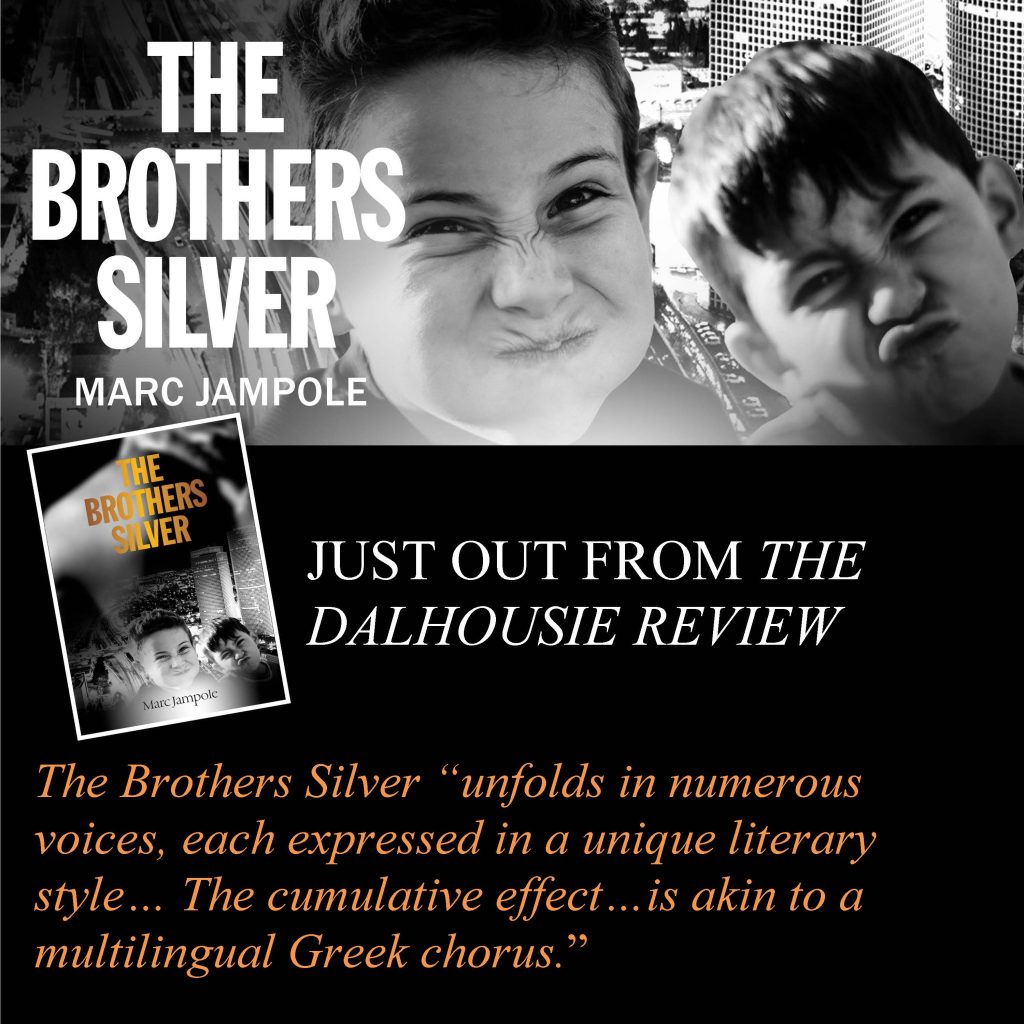
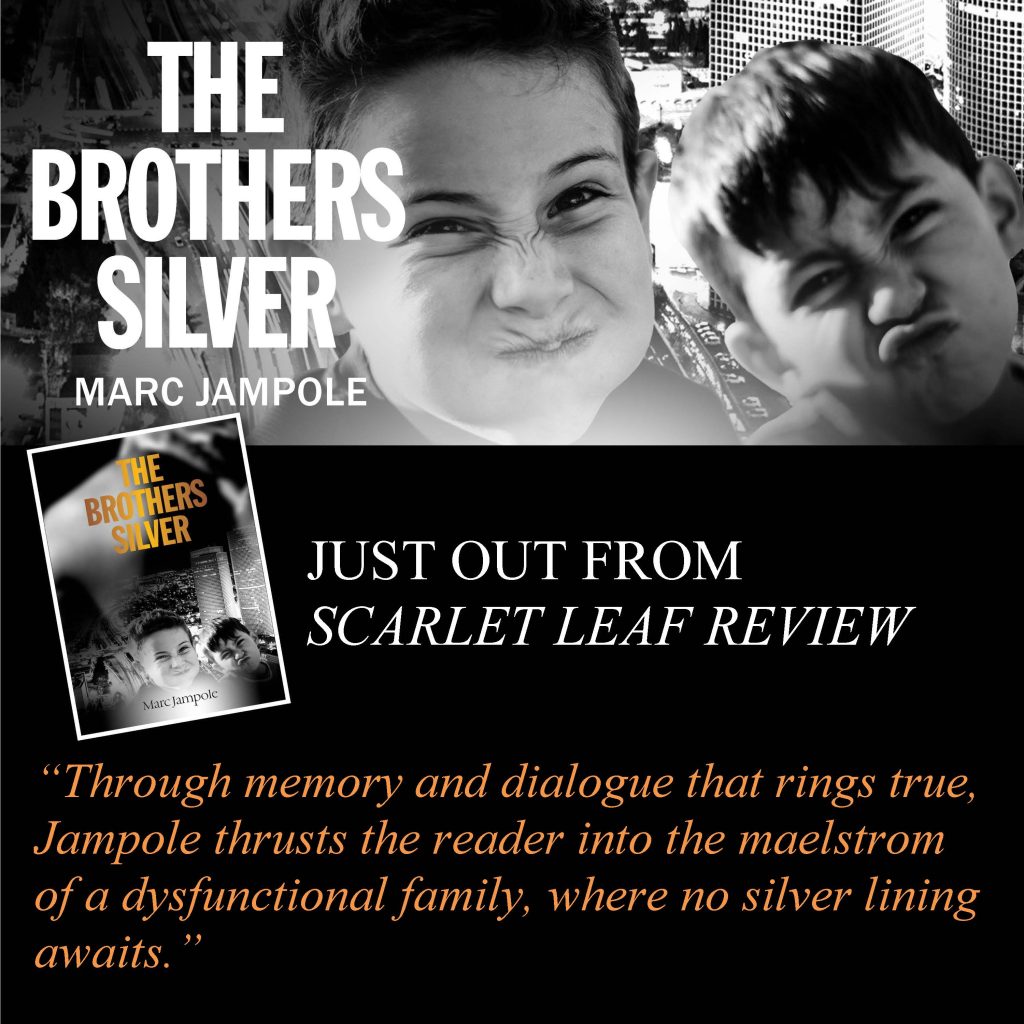
GREAT REVIEW OF THE BROTHERS SILVER IN THE LATEST VASSAR REVIEW:
Countering Culture by Jessica de Koninck
The Brothers Silver by Marc Jampole (Owl Canyon Press, 2021)
Stories of family trauma, parent-child relationships, and sibling rivalry are part of the human psyche. They are central to the opening stories of the Bible as well as to those of earlier traditions. In the original trauma, God expels Adam and Eve from the garden. Eve gives birth to two sons. Sibling rivalry begins, culminating in Cain murdering Abel. Am I my brother’s keeper? (Genesis 4:9) is a question that continues to repeat. The Book of Genesis is filled with dysfunctional families and siblings with difficult relationships – Isaac and Ishmael, Jacob and Esau, Joseph and his twelve brothers. The patriarch, Abraham, sets out to kill his son, Isaac. Death, deception, and betrayal characterize our earliest tropes.
Into this tradition enters The Brothers Silver, the first novel by poet and non-fiction writer Marc Jampole. The book represents a highwater mark in the history of stories of family trauma and sibling rivalry and the kind of book you want to talk with someone about after reading. It is also a story of the Baby Boom generation, and the time period from the late 1940s to the turn of the 21st century. The story crosses the continent from East to West and North to South, starting in Queens, NY, and moving on to Florida, Illinois, California, parts of the West, and back to the East Coast. Novels by men about sibling rivalry are not new. Consider the various intrigues in the similarly titled The Brothers Karamazov. Parenthetically, one of the pleasures of reading The Brothers Silver is the many literary and other references and allusions scattered throughout. There is no detriment to not recognizing them, but recognition adds its own thrill. Again, like Jacob and Esau, The Brothers Silver concerns two brothers, Jules – the older, and Leon – the younger. Typical of many families, particularly those with absent parents, the older son is the caregiver, but also deeply competitive, fearful of losing his birthright. Meanwhile, the younger is detached and depressed, but strong, smart, and handsome.
Less typical of novels written by men, The Brothers Silver is an in-depth exploration of the impact of childhood family trauma on the lives of two boys whose parents are abusive and neglectful. Their father, Ed Silver, who asserts that “all women are whores,” is a largely absent narcissist, unwilling or unable to provide financial or emotional support. Their mother, Ethel Silver, experiences severe mood swings and errant behavior, leaving her unable to hold a job, care for her children, or manage anything about her life.
Writing about family trauma is also not new to literature, though it has unfortunately and often disdainfully been negatively characterized as confessional writing in both memoir and poetry, as if certain life experiences were either too embarrassing or too unworthy for literary exploration. In conversation, Jampole noted: Being a victim myself of childhood abuse and neglect, and someone who struggled it an adult – the largest part of the struggle being admitting it, because I am, of course, male – I basically wanted to write about this subject.
Jampole writes from the poetic tradition. Despite the brilliance of the poet Robert Lowell, who may reasonably be called the progenitor of confessional writing, there appears to remain a sense that the exploration of feelings belongs to the realm of women writers and is less serious or worthy as subject matter. The Brothers Silver rejects that negative assessment and unflinchingly explores the origin and impact of childhood trauma. The novel explores its lifelong impact and the difficult and long-term work necessary each day in order to survive. Childhood trauma, Jampole noted in conversation, is not like a disease that you cure; it’s a disability that you learn to live with.
The book opens with the two young boys, Jules and Leon, wrestling, on the dusty floor of what turns out to be the courtroom chambers of the judge in their parents’ divorce hearing. The scene is heartbreaking. The nightmarishness worsens as their mother, popping pills, drives the boys home and, in a stupor, must be persuaded out of the car. There is an argument in the kitchen with their father about signing the divorce papers. Sometimes the house is clean, and meals are available. Often the boys are left to fend for themselves. Their situation, contrasted with Jules’s happier recollections and hopes that things may change for the better, only gets worse. The brothers remain helpless in the face of their mother’s repeated suicide attempts and inability to hold a job and their father’s physical absence and emotional unavailability.
The Brothers Silver is also a literary novel. As a result of both the authenticity of the child’s voice and Jampole’s use of language, the opening chapter is extremely powerful in establishing the source of trauma. For those who read for writing, the Brothers Silver is a glorious adventure. While the remaining chapters are not as fluid or compelling as the opening one, each drives the narrative, explores the possibilities of language and form, and mixes genres with fluidity. The text is keenly attuned to music, from the rhythms that permeate the chapters to the songs playing in the background or on the radio. Indeed, music, chess, politics, and philosophy are just a few of Jampole’s interests that The Brothers Silver has sufficient gravitas to explore.
The Brothers Silver contains twelve chapters, each of which can be read as an individual work, But the whole is larger than the sum of its parts. The opening chapter, “On the Cold Hill’s Side,” is particularly effective as a stand-alone piece. “Hashmal,” a hilarious drug-crazed romp through a soon-to-be-closed Mikvah (Jewish ritual bath) appeared in publication previously. Each chapter is written in a distinct voice and style. It is a work of literary fiction in the best tradition thereof. It harkens back to the mixed genre explorations of John Dos Passos, one of Jampole’s early influences. As noted, “On the Cold Hill’s Side” is recounted in the voice of a pre-adolescent child. Jampole carefully employs the language and diction of childhood. At the same time, the adult reader’s understanding of the consequences of Ethel and Ed Silver’s behavior makes the experience for the reader and the reader’s compassion for the children that much more intense. While set forth on the page in prose format, the opening chapter is largely written in rhyme and meter. The attention to sound has a trance-like effect, pulling the reader along into the childhood world of Jules and Leon. Jampole, in conversation, emphasized his interest in writing novels using rhyme and the relationship between rhyme and meter to create emphasis. His use of poetic strategies to drive the narrative voice, with each phrase amplifying the next, contributes significantly to the effect of the opening chapter as a whole.
For example, this excerpt finds the Silver boys in the kitchen: Inside, sleeves above my elbows, tie unclipped, I search the fridge and cabinets for something we can eat. Eggs to scramble, grated cheese, some onion dip, a box of Cream of Wheat. I talk of Mantle’s injuries to Lee, Howard at the plate replacing Yogi, how Whitey with a mighty curveball put a collar on Sherm Lollar, why I think the Reds will tank, why Matthews is as good as Ernie Banks, Cepeda, McCovey, other Giants. I speak to fill my brother’s silence. Not only has Jampole established the setting of a boy working to feed himself and his brother and provided a time frame with the use of baseball examples, but, significantly, the hypnotic iambicpace filled with rhyme – “Lee” and “Yogi,” “collar” and “Lollar,” “tank” and “Banks” – creates an immersive experience for the reader. Immediately before recounting the trauma that closes “On the Cold Hill’s Side,” Jules recites a lengthy lyric daydream in an attempt to fit together the broken pieces of his life. The reader understands that nothing makes sense to Jules and that, though he has been warned not to, he will blame himself for whatever has happened or will happen.
As with each succeeding chapter, the second chapter shifts tone, voice, and writing style. Jampole believes it essential to tell the story in different voices in order to gain a more complete perspective on the characters and their situation. Chapter Two is a soliloquy in the voice of Ed Silver, father of Jules and Leon. The boys are now on the verge of adulthood, Jules is in college, and Leon has taken off for San Francisco. This claustrophobic use of monologue is a particularly apt vehicle for a character with a limited world view who is deeply narcissistic. He understands neither his older son’s idealism nor the younger’s distance.
The third chapter moves to dialogue in the voice of secondary characters, an aunt and uncle. This may be the least successful of the chapters as an experiment in the use of language. Its emphasis on Southern dialect often feels forced and the characters one-dimensional. Yet the next chapter, a third-person dramatic dialogue, skillfully personifies Jules’s feelings by affording each one of the characters a literal voice. Here’s a brief sample in which the language feels fresh and satisfying. Guilt: Unconscious mother, barking television, plastic vials, glass half filled with water, knew it was all my fault. Shame: Stupid, stupid, stupid, not to see her breathing. Not to see she was still alive. Anger: I knew she was alive. I wanted her to die.
Another chapter is in the form of a letter. Like the first chapter, the final chapter is lengthy, approximately one-third of the entire book. It, too, is in the voice of Jules, now an adult, forty or so years after the first chapter. Like the opening chapter, the final one, titled “Along an Unknown Highway,” employs poetic strategies, but here the vocabulary, syntax, and diction are those of an adult in which Jules takes a lengthy road trip.
Jampole pays homage to the long tradition of road trip stories with a quote from among the earliest, and certainly the best-known, opening with a quote from the beginning of Dante’s Inferno. The epigraph reminds the reader that it may be necessary to go through Hell to have any hope of getting even as far as Purgatory, let alone Heaven.
The extended road trip affords the opportunity to explore the turn of 21st-century American Zeitgeist. It’s a lamentation for the promise of the 1960s and the disappointing realities of the 2000s. Jules, driving alone, traverses the country to visit with an assortment of characters from his past, including people met while hitchhiking. Indeed, hitchhiking, a largely lost 20th-century phenomenon, is a central metaphor of The Brothers Silver. What would Jack Kerouac have had to say had he repeated his own road trip?
The opening paragraphs of the chapter, through their use of poetic tropes as well as literal language, make Jules’s road trip one that occurs both within and transcending space and time: The tumbling sky shivers like my bleary body from the wind of speeding cars and trucks. Squinting drivers steer into a quivering solar ball that singes roads and signs, sears the fences, flames the crows and ducks. In my sight, glowing malls cross horizon’s edge and welkin squid-ink stains the spurge and sedge, leaches roofs and building cranes, dims the city structures into specks of light.
The birth of night releases cicada humming, beetle scuffles, wind and spider throws. Moisture stumbles over dell. Wind song and cricket clatter swell and grow to ostentatious silence. A white noise knells. Time ceases giving hints of its existence. Jules’s journey is most compelling when it affords him the opportunity to meditate or advances the narrative. His trip is less interesting when the characters begin to feel more like stereotypes than archetypes, and the narration becomes didactic rather than revealing.
There’s one of almost everyone – the drug dealer turned physician or politician, a lawyer who represented draft evaders now a management labor lawyer, a born-again Christian, black, white, gay, straight, inhibited, uptight. More men than women. With the exception of Ethel Silver, the female characters, including Jules’s former girlfriend Elaine, whom he calls El, are, for the most part, less fully realized than the male. There’s nothing particularly fresh about a drug dealer who grows up to be a psychiatrist. In light of the serious psychiatric problems among his family, more interesting is Jules’s aversion to medication for ADHD, and, by implication, other medications for psychiatric disorders.
The adult Jules, like most of the characters he encounters, has given up the idealism and hedonism of youth for financial security, routine, and certainty, but he was never an actor who tried to effect change. His principal and most important skill is survival, while his observations about complacency border on the trite: But I was, nevertheless, part of the obscene machine that ground down the dream of a social democracy that we seemed on the path to reaching in the mid-seventies. I once believed fervently in the possibilities of a social democracy overseen by a real meritocracy, where everyone had a chance to thrive, a green land that provided a minimum standard of living, and free healthcare and education to all, financed by taxes on the wealthy, something like France or Scandinavia. That was then. Has my later apathy been any different from Dean’s? Yet his occasional focus on who has gained too much weight is entertaining and creates a sense of reality.
Jules’s reactions to, and coming to terms with, who each of these characters both was and has become ground the story and maintain momentum, even when the people themselves begin to become repetitive. Similarly, Jules maintains his feeling of being an outsider throughout. While the ideological/political thread in the story of Jules’s trip feels somewhat forced and superficial, his continuing meditation about his failed relationship with Elaine provides a deeper understanding of Jules’s character. The reader is left almost as baffled as Jules himself at his subsequent ability to establish and maintain a long-term marriage and a stable relationship with his daughter. He believes it relates to his ability to view himself as the perpetual outsider.
His outsider status is the wall Jules has created to distance himself from his emotions. Yet his ability to connect with people he has not seen for years, his successful career as well as the family relationships of his adulthood, feel grounded and real and speak of a level of hard work and commitment for which Jules never gives himself credit. That lack of acknowledgment of self-worth resonates as the residue of a traumatic childhood. It is a corollary to taking on the perpetual role of outsider.
None of us is truly our brother’s keeper. We can offer help or guidance, but, in the end, we can only live our own lives. And none of us can escape whatever trauma life has brought us. The challenge is how to live with trauma. Do we live in denial, build walls to shut out feelings? Do we live in perpetual adolescence without daring to explore the possibilities of adulthood? The damage of childhood trauma, will, to a greater or lesser extent, always be permanent. The challenge presented by The Brothers Silver is the challenge to survive.